Showing posts with label work. Show all posts

Wednesday, October 19, 2011

Spying on my Neighbors and Indianisms

After sleeping off and recovering from my Singapore trip, I started noticing some changes to my next-door neighbors. The windows from my flat and from work face the same apartment building to the east. About ten feet from the entrance to my building was a small row of about seven slum shacks. Slums usually spring up where there is construction, as the families who work on the construction site move near the building for the duration of the construction. This row of slums has been here the whole time I’ve been here but I noticed one day that two of the shacks were empty. Then after returning from Singapore I noticed that the slum had been emptied out leaving behind their discarded belongings. I guess construction has finished.
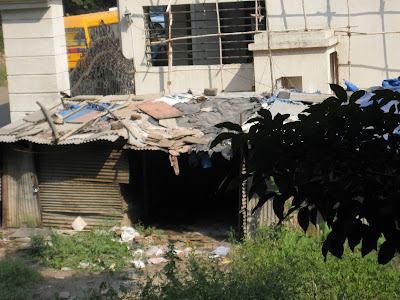
One empty shack

Now they're all gone

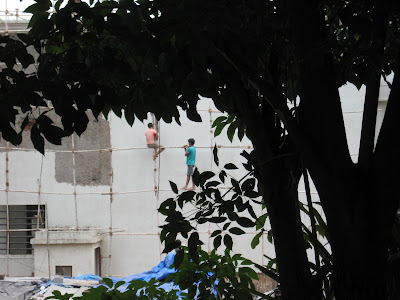
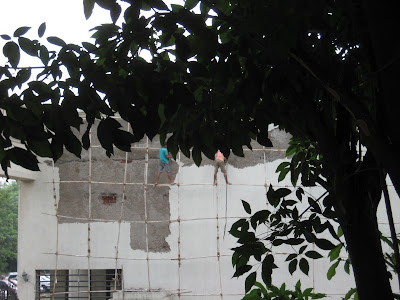
I also noticed a lattice had been propped up against a building, and then there were two men just balancing on the horizontal beam. These guys are like thirty feet above concrete on a very flimsy plastic matrix held together with what I imagine to be strong string (twine?). And then here they are chipping away at the wall of the building, causing their support to wobble with every whack they take. I was nervous for them the whole work day as I would look over and see them climb up and down to continue hacking away at the wall. I was also thinking how this would absolutely never fly in the US. They would be breaking like hundreds of safety codes.
Chipping away at the wall

Moving to the next section of wall

Also while living here I’ve adjusted to Indian idioms in English.  These are a few of my favorites:

“Double #” Anytime there are number read off and two of the same number are in a row, like two 9’s as in my phone number, you say “double 9.” When numbers were read to me and someone would say “double #” I would begin to write down the word “double” because my brain was in strict regurgitation mode. I also noticed if I said “9, 9” then the person taking down the number would pause and convert it to “double 9” in his head. But I’m Indian now and everything is double #.

“Kindly” or “you are kindly requested to do the needful” This seems to be a vestige of British English. What is needful? Does that mean what is needed to be done? If you receive an email that requires action on your part you are “kindly requested to [action here].”  I guess that’s a very nice way of putting it, but in my American experience it’s more “please complete [action] by [date].” It almost sounds like they are asking you to RSVP for something.

“Prepone” You guessed it, prepone is the opposite of postpone, and is very logical. You can postpone a meeting but there is no equivalent word of moving up a meeting. Bravo to Indians for this one.

“I stay in [place]” In this case stay just means “live.” “I stay in Mumbai” means “I live in Mumbai.” To me “stay” as a much more temporary connotation, like you are staying somewhere for a few days, but you permanently “live” in your hometown.

“Are you leaving station?” This is asking if you are going out of town. This one really confuses me, why is your house your station? Or is station referring to your hometown? And why is it a station? I still haven’t wrapped my head around this one.

“My native place” Your native place is where you grew up. This is a reflection of the diversity of cultures and identities within India. Every state has a different language, and village culture is vastly different from urban culture. “Native” to me sounds very foundational, like at the root of your ancestral history your family is originally from [country]. But here it refers to the village or block (a form of municipal districting) where you grew up.  It’s the equivalent of saying “I stay in San Francisco, but my native place is San Diego.” To me it implies that San Diego is this completely foreign, wholly different culture and place than San Francisco (yes they are very different).

"A/C and non-AC" "Veg and non-veg" These are pretty self-explanatory. When booking a cab or a room you are asked if you want A/C or non-A/C. Predictably the A/C amenities cost more but depending on how sweltering the weather is, is totally worth it. All packaged food and menus indicate whether food is veg or non-veg (which is like a double negative for me) and the vegetarian food has a green dot while the non-vegetarian food is marked with red. Subliminal much?

Wednesday, September 14, 2011

Ganesh Chaturthi

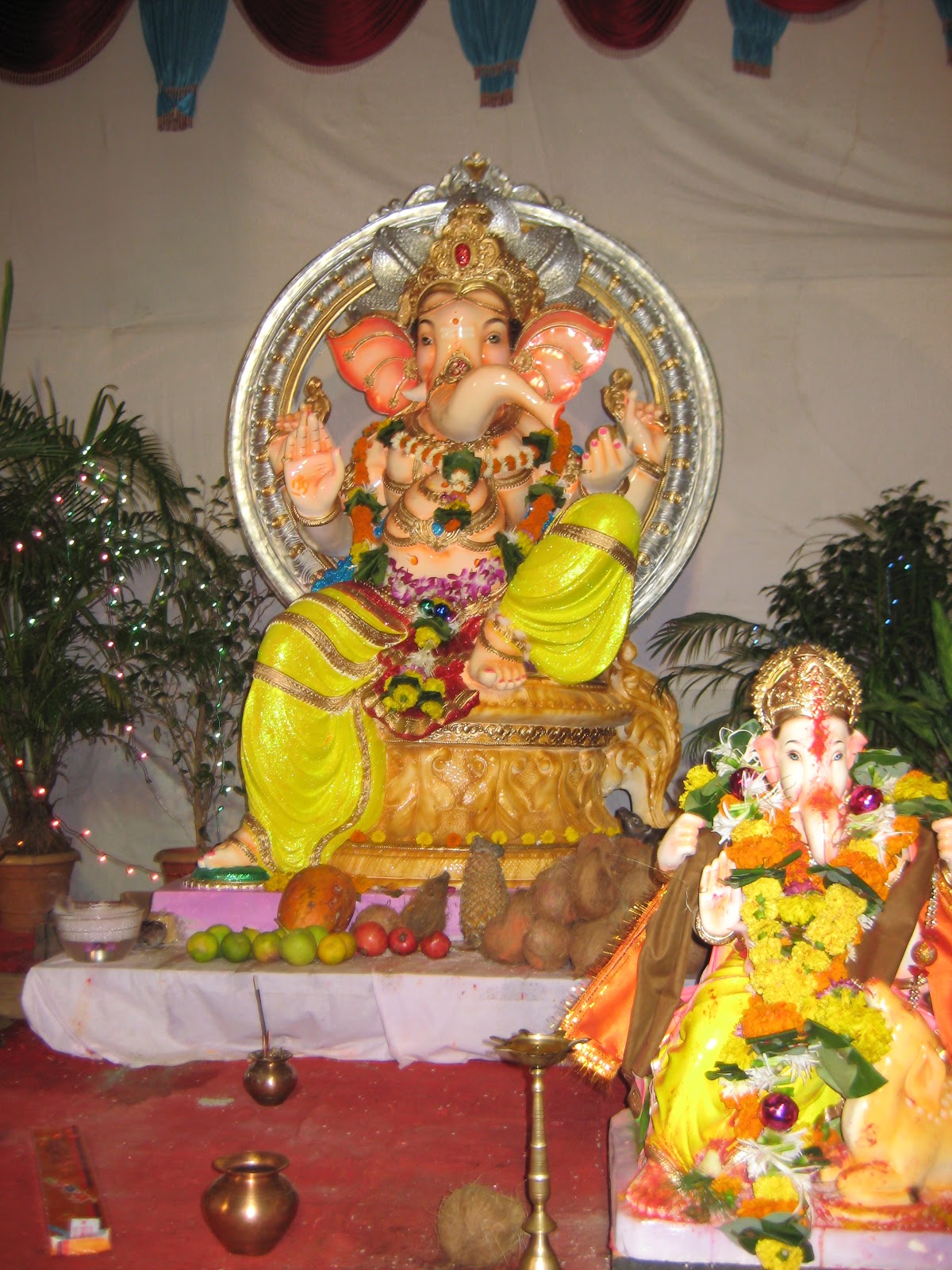
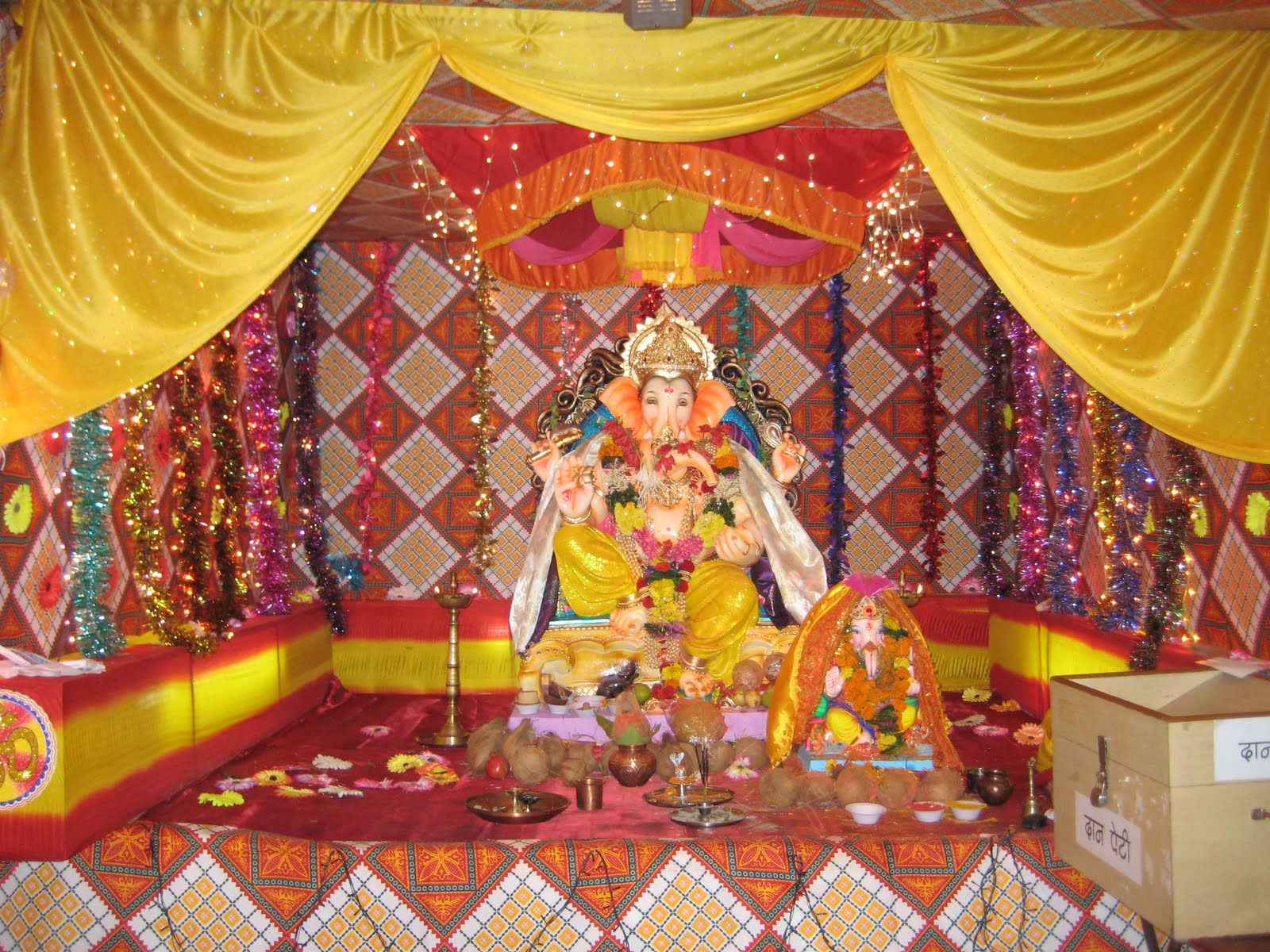
One of the festivals I was looking forward to experiencing while in India was Ganesh Chaturthi. Because I am so close to Mumbai, I was excited that I would get to witness this great celebration. I’ll be honest and admit my initial interest was sparked by Shantaram, but is that so bad? Anyway Ganesh Chaturthi is the Hindu festival of Ganesha, who bestows his presence for all his devotees on earth during the festival. He is the god of wisdom, prosperity and good fortune, and was declared by Shiva as superior to all the other gods. Shiva is Ganesha’s father and one of the most prominent deities in Hinduism. Artisans make models of Ganesha and sell these two to three months before Ganesh Chaturthi. These are then installed in homes and public places. The public ones are larger and beautifully decorated, with communities competing for the most beautiful and biggest statue. Priests then invoke the statues to life through mantras and then the statues receive offerings. For ten days Ganesha is worshipped, on the eleventh day the public statues are carried through the streets in a procession with singing and dancing. Then they are submerged in water as seeing off Ganesha to his home in Kailash and taking the misfortunes of his devotees with him. The family Ganeshas are taken to the water on the third, fifth, or seventh day depending on the family tradition. It’s a huge event for the communities as well as artists and businesses that depend on the economic success of Ganesh Chaturthi.

There is a lake in the city I work and live in, and one of my co-workers offered to take me on the seventh day to see the processions and the submersions family Ganesha to the lake. She happened to live by the lake and had a motorbike so I hopped on and was excited for the adventure. There is a lot of fanfare for each procession! We were stopped in traffic from about a half mile from her house as the processions took up the whole street and were moving forward at a slow walking pace. On the way she took me to two of the public Ganeshas and they were beautifully and extravagantly decorated. The families themselves did not submerge Ganesha, but there were volunteer divers who would take the small Ganesha to the lake and immerse it. There was also police monitoring the procession route and the area near the lake, I guess because people can get a little rowdy? 

One public Ganesha on the way to my co-worker's house.

The public Ganesha at my co-worker's building.

One of the many processions we encountered. We are driving on the wrong side of the road to bypass it.

Now you see it, now you don't!

Monday, July 25, 2011

Workplace Culture


My pre-departure training focused on many aspects of living in a foreign culture and included examples of how the workplace culture can be different from the Western workplace. The aspects I kept in mind for India were the fluidity of time, the hesitance to give any form of bad news, and very rigid bureaucratic hierarchy. I told myself that these would be different and might really fly in the face of my dislike for tardiness and appreciating when someone was straightforward with bad news instead of just saying yes to save face. I was ready, I might have a hard time at first but I know these are the things to look out for.

I was totally not ready. Living in the midst of it, where deadlines aren’t usually given, and if they are then they are very flexible, and in a culture where it was more important not to break bad news than to be blunt with it was very different than knowing to confront these things. When I would ask when a co-worker if he could please do this task by a certain date and it doesn’t happen, my instinctual reaction would be frustration at making me behind in my deadline and why he didn’t simply tell me that he was overloaded with other work and just wouldn’t be able to get to it. In the heat of the moment it never occurred to me that this situation is exactly what the training was for. After weeks of frustration, I’ve realized that the workplace culture is just different. I was finally able to see this is what fluid time means, how important it is to save face or not give bad news. The switch in my head went off and now I am at ease at work. Time fluidity is embraces the attitude that things will happen when they happen. There just isn’t the obsession of getting things done by a certain time; there isn’t really a bad consequence if it’s not done by a certain time. The world really doesn’t end if I don’t get the spreadsheet on time. I am actually grateful that things work differently here; I can sometimes be very rigid and by the book with work. But here I have learned to take things as they come, and using my judgment to determine which situations require me harping a little on the deadline and which situations I should just let play out. The harder aspect to get used to is the hesitance to give unhappy news. This can range from “sorry I won’t be able to finish that today” to “I will not finish this assignment because I don’t know what you’re asking me.” This extends to everyday life as well, when auto drivers will say they know what obscure building you want to go to. At times I’ve discovered they haven’t understood what I said but nod and say “yes.” I’m still trying to figure this one out, I understand how wanting to save face is important but I also think being straightforward will accomplish more in the long run. I’m sure they know that as well, so I’ve tried to figure how to work with it. I’ve found that people are so incredibly helpful when I ask for help, on the street when asking for directions or at work. They don’t seem to judge me when I shrug and say “I don’t know,” so I’m curious why people I’ve become familiar with show such hesitance to asking me for help or showing they might need some further explanation. The rigid hierarchy also took a little getting used to. Every assignment that is finished is sent to peers and superiors for feedback and comments. Thus the process of completing a simple assignment can take weeks and months waiting for all the feedback and implementing all the comments received. This is a complete departure from what I’m used to. I remember starting out in my work and being surprised that I was asked to complete assignment for formal submission without a review from my boss. One time I asked “You don’t want to look over it?” and my boss said, “no I’m sure you did fine.” I guess I got used to just submitting briefings and deliverables, but now everything I write or review is reviewed again. Hopefully I can jump back into non-reviewing mode when I get back. Although it took a few months, I’m glad that I’ve adjusted to a different workplace culture. We’ll see how the reverse culture shock goes when I return to work in the US.

Tuesday, June 21, 2011

Out in the Field

With my job here I have the opportunity to travel around the state of Maharashtra. In an official capacity these are monitoring visits to evaluate how the program is doing in the field and to implement a volunteer management database. I get to go way off the beaten track and stay in villages that are beyond the reach of the Indian railway system, a very extensive system that is the world’s largest employer. These villages have been several hours away so traveling requires leaving the night before, spending the night on the bus, and arriving early in the morning to start a full day of field visits. After two full days of going from village to village we spend another night on the bus to come home and leave to start all over again. I’m a pretty light, fickle sleeper so I’m usually exhausted before the work day even starts. However I’m grateful for the opportunity to see how people outside of the major cities live. It’s been an eye-opening experience to say the least. Language is more of a barrier since fewer people advance in education. Through some tireless translation I’ve learned several of the obstacles that people must overcome.

In one village I visited were campaigns addressing three main issues: violence against women, caste discrimination, and education. In my field visits I didn’t meet a single woman, all meeting participants were men. Women in civic and social participation is abysmal, and their absence was disheartening. However there is a small group of women raising awareness about violence against women. Caste discrimination is present in urban areas, but it is in full force in the rural areas I visited. One brave young man from a lower caste campaigned for an open position on his village council but was defeated due to opposition of his caste background. He continues to campaign for social awareness and now serves on three village committees (unelected positions.) Another issue is education, families move where the crops are so their children do not receive consistent schooling. The organization I was visiting has set up programs for education gaps so children can make up for lost school time.

However I had some great Indian food, I’m getting decent at eating with my hands now, although I haven’t quite mastered only using my right hand. Traditionally eating with your left hand was seen as unclean, although this is not prevalent anymore. Tearing roti with one hand is pretty challenging and I don’t think I’ll master single-handed eating before I leave. 
Most meals consist of wrapping roti around an assortment of vegetables, using your hand of course.

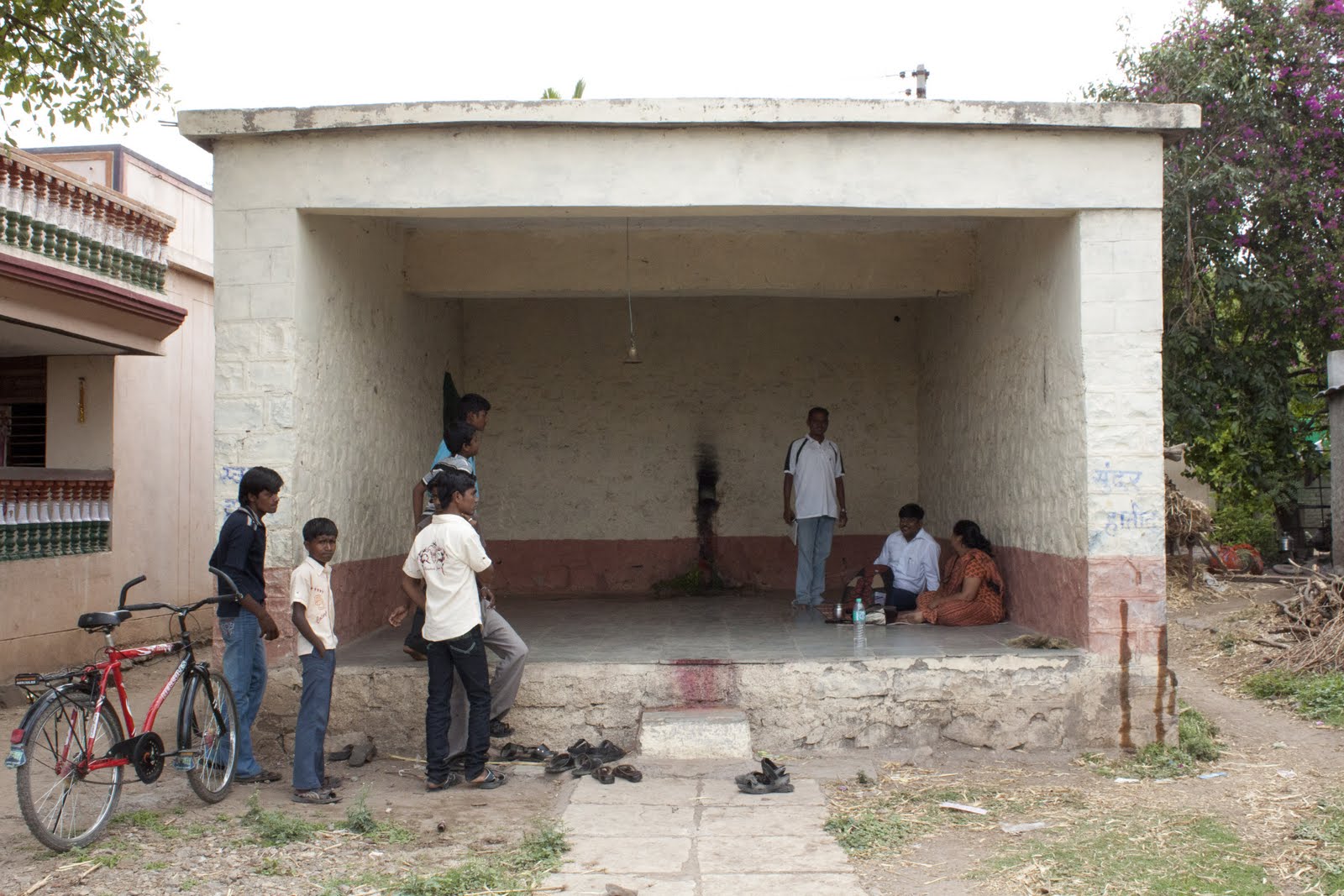
Community center where one of the field meetings was held. The smoky column in the back is a Hindu shrine.

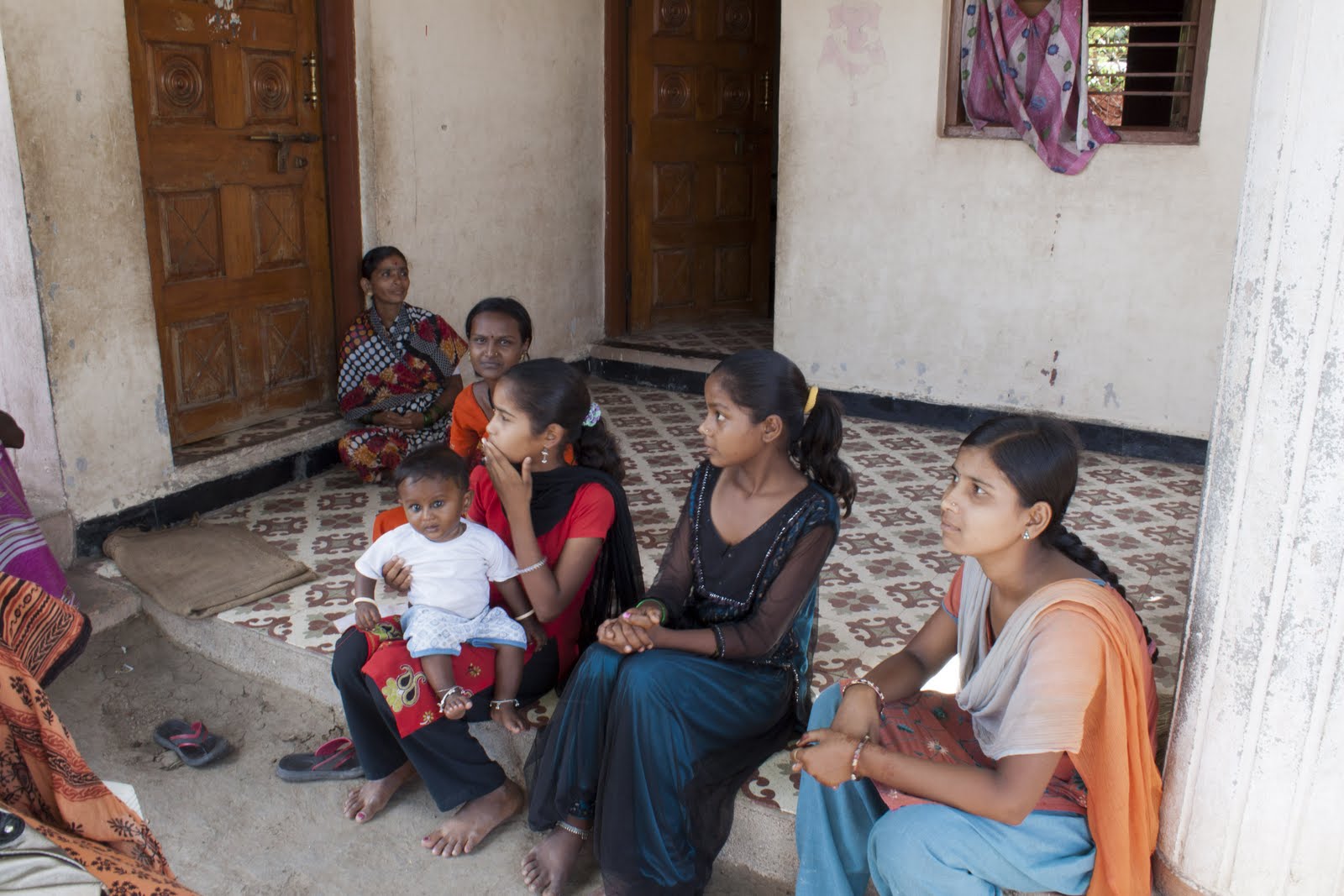
Women right beside the meeting who didn't want to participate, but wanted me to take pictures of them!

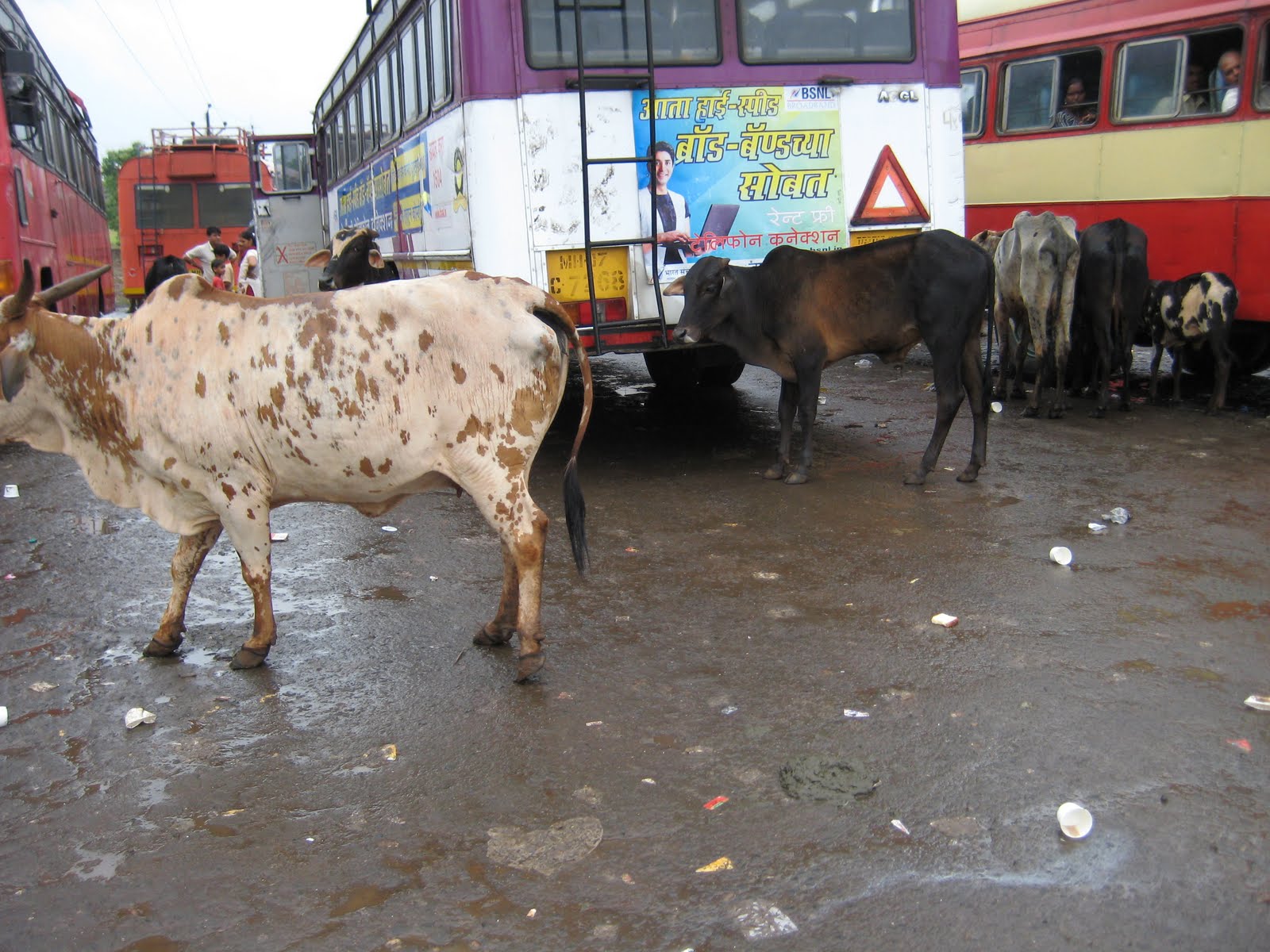
On my last day of field visits I came back by myself. Getting home involved taking a bus to Mumbai and another bus to Navi Mumbai. I thought to myself, taking a bus to Navi Mumbai doesn’t make sense because I could take the train and I’m sure there will be gridlock traffic. As the bus entered Mumbai, it turns out there was gridlock traffic. The conductor yelled out if anyone wanted to get off at Kurla. I have only been in Mumbai once but I recognized the name as a stop on the rail line I could take directly into Navi Mumbai. I said I wanted to get off the bus, so I leaped over a three foot wide puddle to land on the muddy streets of Mumbai. At this point I had been on the bus for five hours, since seven that morning, and was exhausted from days and days of field visits and traveling. The bus driver pointed me the way to the railway station and off I went. The sheer amount of people on the street would have been overwhelming enough, but navigating the traffic and muddiness tested my resolve. When I decided I was just going to get my feet muddy I almost ran into a cow and its huge pile of “fertilizer.” I then realized that I don’t mind mud on my feet but I do mind stepping in piles of fresh cow dung. Unfortunately there is no way to distinguish regular street mud from cow mud so I picked my steps carefully toward the train station. I tried three times to get an auto rickshaw to take me but it was just too close to be profitable for them, yet just far enough for me to know I had to focus on my end goal. About 15 minutes into my trek I was able to get a tuk tuk and got dropped off at the train station, where I was confronted with a mass of people which apparently were eight separate lines for the tickets. These eight lines were spilling out onto the streets. Completely disheartened I decided to ask two gentlemen where I could get a bus to Navi Mumbai. They asked why I would ever want to take a bus as that would take 2-3 hours with traffic and a train is only half an hour. I pointed to the line and they understood. One of them handed me a coupon and said, we need to find more. I had no idea what he was talking about but followed their lead as they began asking people for more coupons. Apparently these coupons are prepaid, and stamping them in a little machine at the station with the correct amount for your ticket will act as your train ticket. They asked several people if they could please spare a 10 rupee coupon, a 5 rupee coupon. I didn’t think this would work, why would people willingly give up these golden coupons that let you get onto the train without having to stand in a 100-person line? But it did, it did work. People did give these men their coupons. In about three minutes we had enough for my train fare, in fact we had more than enough. The men stamped my coupons and I ran toward the platform. I made it onto the next train and decided not to sit, but stand near the open door and get some fresh air. I had been reading articles on how sitting is bad for you and after sitting on buses for several days I decided I could stand for half an hour. I got to home/work just before lunch.

After days of being in the field and being astonished at the resolve of these people trying to make a difference against all odds, I was completely blown away by the kindness of these two men and all the strangers they asked for coupons. I’m sure they had somewhere they could have been, but these men went out of their way to find coupons for me; they did something for me I’m sure they wouldn’t have normally done for themselves. And yes, several people said no when asked if they could give up coupons, but many people said yes and some people even volunteered their coupons. I was just blown away. Yes people in India and everywhere face harsh adversity, but they have kindness that I haven’t seen often. Yes India can sometimes be dirty, but it has a clean heart.

Cows blocking my path to the bus door.

This is what I mean when I stood and got some fresh air on the train.

Friday, June 10, 2011

Expats and the Monsoon

Before coming to India I told myself I would make an effort to make friends with locals and limit the number of American friends I had. After leaving France I wish I had spent more time with French people and made some French friends. Part of an international experience is making international friends and speaking the language right? Well in India I have found it a little harder to make local friends. Firstly, men and women don’t usually hang out together so that eliminates half the population. Because of this, I’ve found that their attitude and interaction toward me tends to feel awkward and uncomfortable. I’m thinking that if single men only associate with women for romantic reasons, then that’s the way they are accustomed to interacting with women. Also, I’ve found that our interests and preferred topics of conversation don’t usually align so that is another obstacle to overcome. Anyway so that leaves women. But walking around India you will notice there are very few women just walking around outside. Add to this the same difficulty with topics of conversation and language and there is a real difficulty in meeting people.

After spending the day working with locals, I’ve decided that it won’t be so bad to have some expat friends here. It’s not France where I would spend class time and free time with Americans, here I can spend work time with locals and free time with Americans. So I’ve found a great group of women, all who are here because their husbands are here for work. This is the main difference between us but it’s been great talking with people who are going through the lifestyle changes I am. One of them is an American who has opened a shelter for street children (www.tenderhands.org). The best part may be that she also runs an American bakery, the proceeds from which benefit the shelter. This bakery is amazing, I have been missing American desserts the whole time I’ve been here and now I get to treat myself to the cupcakes, pies, and cookies I’ve been missing. I get a taste of home and supporting a good cause. Can’t get much better.

Otherwise the legendary monsoon has arrived. I was told the first couple days would be worse than the heat because it would be combined with the rain, making you feel like you’re in a steam room. But, knock on wood, it is now very cool. The cloud cover provides a buffer for the heat and there is a very refreshing cool breeze that comes with the rain. The only down side to the rain is that all the streets are muddy and going anywhere will mean you get soaked. Oh well, so far I am enjoying the relief from the heat. Hopefully I won’t be discouraged to do my regular grocery shopping. My coworker told me which shoes to buy for the monsoon. When we think of footwear for the rain we think of rain boots and galoshes so that our feet and clothes stay dry. He told me I should buy sandals made out of either rubber or plastic that have straps both around my foot and heel. The sandals are so that your feet will dry more quickly once you get out of the rain, and the rubber and plastic is so your shoes will also dry. Most shoes here are sandals, and most of these sandals only have on strap going across the top of your foot. However it is important to have these two sets of straps because when you walk on the streets, the water and mud levels will rise, and you risk getting your shoes stuck at each step because of the mud. Thus, the two straps will secure the shoes to your feet, and your feet, shoes, and pants will dry with the mud caked on them. I love the approach. In the States we avoid getting wet at all, with galoshes that sometimes go up to our knees or higher, and making sure we tuck our pants in. In India, you know you’re going to get wet, avoiding the water is almost impossible so face the problem head on and make preparations to make the aftermath easier. It’s great, I just need to get used to being muddy sometimes.

My awesome monsoon-proof shoes.


The view outside the entrance of where I work/live.

Wednesday, May 11, 2011

Monthiverssary in Mumbai


Alas, I have been in Navi Mumbai for a month, in India for two months and I’m starting to feel a little homesick. Specifically I miss meat and the suburbs. And I’m surprised at both of those. I’m not a huge meat eater by American standards, but I am a HUGE meat eater compared to any vegetarian standards. I realized I usually had meat for at least two meals a day, and I’ve been feeling the effects of going vegetarian. Firstly, I eat and eat but I’m always hungry. It’s like being on a diet but not losing weight. Especially considering my very protein-heavy eating pattern before leaving for India, my body is craving some amino acids. So now I am able to work either chicken or fish into my dinners, and having eggs in the morning has curbed most of my hunger. But I really miss beef. I miss tacos, steaks, and sushi. A lot. Thankfully, my dear Robert has shipped two boxes of beef jerky and tuna and protein shakes so I will get my protein fill for the next couple months. And yes I miss the suburbs. I’m not a huge fan of having to own a car and the need for driving to get anywhere. I’m a huge fan of good public transport, and being completely self-sufficient without a car. I might be eating my words now. We have to go grocery shopping at least twice a week because we can only buy how much we can carry home. And it’s not a lot. Walking home from the grocery store while dodging unpredictable traffic and cows, carrying about 7 pounds for a ½ mile in each hand can get a little heavy. Oh yea, and it’s been getting hotter. May is the hottest month in Mumbai, before we get hit with torrential rain starting in mid-June. I’ve been told that walking around in the monsoon is the equivalent of standing in the shower for a minute with all your clothes on. Not to complain, but I’m guessing grocery shopping will become a little more difficult. So I miss cars and huge supermarkets and Costco where you can stock up on food for a month. A nice air-conditioned ride from Costco with the trunk full of meat and eggs sounds pretty marvelous. I remember putting off running errands because it required so much energy. I really get a workout now getting my food for the next three days.

Other than that rant, I’ve started to settle into work here. Over the weekend I actually got to do some field work, in a tribal area about an hour from where I live. I took some great video of my transportation experience, but for some reason my computer garbled it. I’m actually pretty sad about that, this video was a true once in a lifetime experience. It was the most perilous car ride I have ever experienced. Until now, my experience of dangerous car rides includes throttling down unpaved hills in Mexico with a notoriously daring driver, and circling the Arc de Triomphe in Paris with a cab driver who was in a hurry during rush hour. I love roller coasters and thrilling experiences, but I actually felt fear for my safety with this driver. The road to our destination mainly consisted of a two lane highway. There was pretty heavy traffic, and we later found out there was an accident. You would think that would make us think to be more careful, but not really. Any time there was a break in the oncoming traffic, and I mean even for a second, he would swerve into the opposite lane to hopefully pass one or two cars before swerving back into the correct lane. This would consist of three opportunities for a horrible accident to happen. The first is when the driver pulls into the opposite lane, more than once he did this even if there was a curve or when the next car coming down the lane happened to be about three seconds behind the previous car. On the times it was safe to continue in this lane, he would wait until the absolute last possible fraction of a second to get back in the correct lane. With his hand out the window he would often graze his fingers against the car that we narrowly missed as it sped past us. This also meant that we would need to be able to fit back into the correct lane. This wasn’t always possible so the driver would simply squeeze in so there would be two cars, or possibly a truck and a car side-by-side where there should have only been one car. When I was filming my video, my boss in the seat next to me warned me to be very careful. We arrived safely and I had a great time talking to the volunteers with the organization.

Thursday, April 7, 2011

Bring on the humidity, Mumbai!

After my first Indian railway experience and an overnight train from Delhi, I have arrived in Mumbai! My first impression: it is HUMID! Delhi has a relative humidity of 34% and Mumbai has a relative humidity of 80% and you can really feel the difference. Add that to 34 degree weather (about 85F) and you just sweat instantly. Just standing outside makes you sweat and sticky. It's gross. My employer is actually based in Navi Mumbai, which is a suburban train ride from Mumbai. I live at the employer's complex and it is pretty nice, which means I don't really have to go outside or have a commute. It takes me about 2 minutes to get to work as I live about 50ft from the office. I share a flat with another volunteer and we're definitely putting some effort into making it homey for the next year. We have done a little exploring and really lucked out with our neighborhood. In one direction we have a 3 story mall with a supermarket (!!!) and McDonalds. In another direction we have roads full of stores of the more traditional Indian fare where we can get good bargains on everything from fruits and vegetables to clothes.

I've also started my role with my employer and right now I'm just familiarizing myself with the organization, its history and its current projects. I have to say I'm impressed with how much the organization has accomplished at the local, state, and national levels. I can't wait to be a part of the change they are already causing.

I know that's not much for now, but I've been taking it easy trying to settle in and make my flat a home. I've also been eaten alive by mosquitoes in the three days I've been here so I'm trying to find a solution for that. Wish me luck!